Overview
GGE was developed for Iberdrola as a platform focused on employment, training, and educational resources linked to the green economy.
The experience needed to support different audiences, from job seekers and students to institutions and corporate stakeholders, while staying clear, credible, and easy to navigate.
Role
UI Product Designer
Contributing in restructuring and evolution of the platform, focusing on product clarity, scalability, and system consistency across multiple user types.
Deliverables
End-to-end UI redesign
Product architecture definition
Design system
Core user flows
AI-assisted workflow design
Brand & visual system
Prototypes and validation flows
Tools
Figma
Figma Make
Adobe Creative Suite
Timeline
1 year
Credits
Juan Sisinni [Product Lead Designer]
Samuel Lazslo [Product Owner]
Andranik Antonyan [Full Stack Engineer]
Mher Sargsyan [Full Stack Engineer]
David Vojnic Hajduk [Frontend developer]
Borko Mihajlovic [Full Stack Engineer]
Maja Horvacki [Frontend developer]
Csaba Korponai [Senior Backend Engineer]
Dijana Gabric [Backend Engineer]

The Problem
The textile sourcing industry operates through highly fragmented workflows.
At the same time, increasing pressure around speed, sustainability, and traceabilityrequires more structured and intelligent workflows.
Material Exchange was designed to transform sourcing from a fragmented, transactional process into a continuous, data-driven system.
Product Positioning
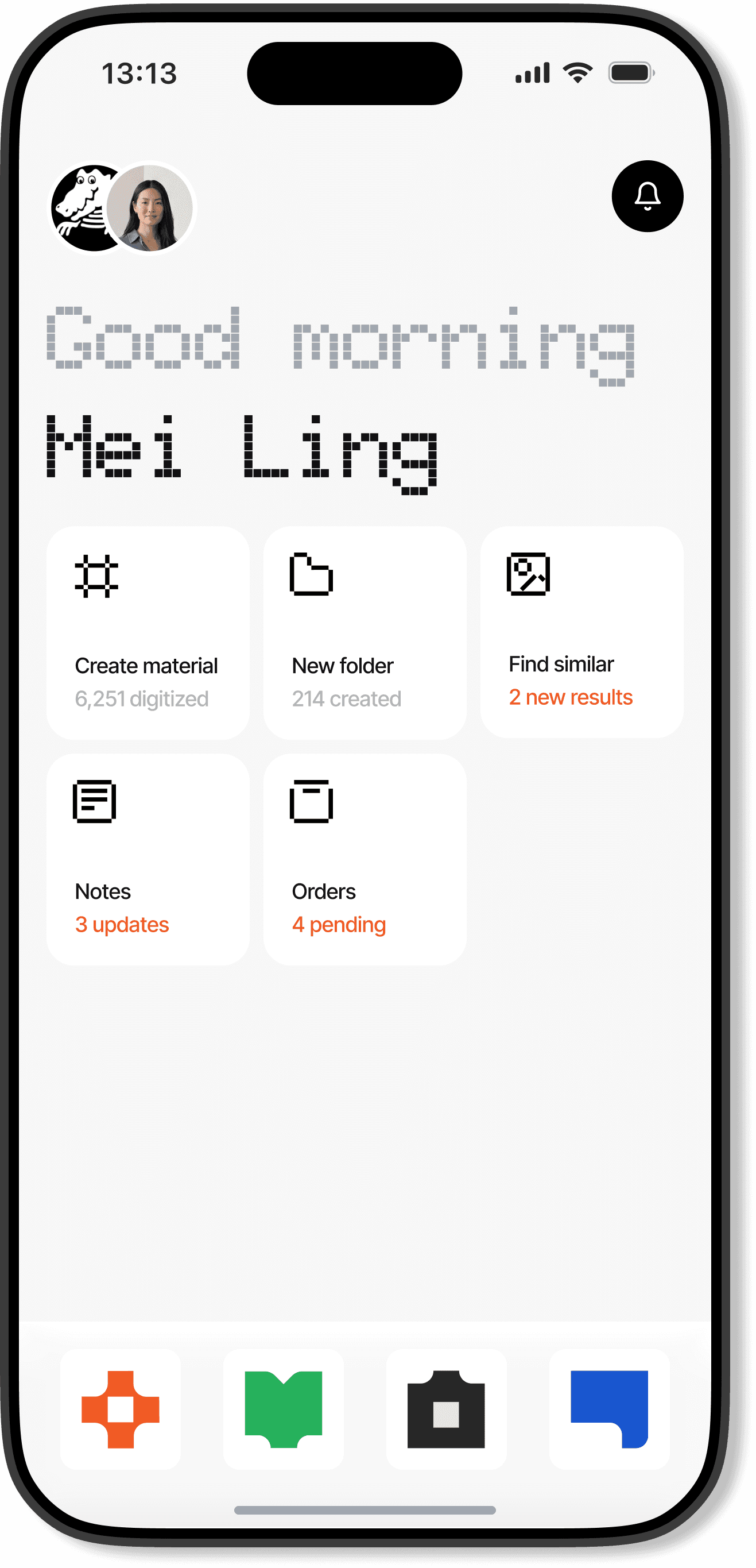
Material Exchange acts as a shared intelligence layer across the supply chain.
Rather than functioning as a simple marketplace, the platform connects sourcing, communication, material data, and supplier relationships into a continuous ecosystem.
The platform transforms:
Sourcing from Transactional → Continuous
Material data from Static → Reusable
Communication from Fragmented → Centralised
Supplier discovery from Manual → Intelligent
Key Problems
The core challenge was not only designing interfaces, but defining a scalable system under uncertainty.
Material Exchange was already an established startup with active industry relationships and a growing product ecosystem. However, the platform lacked a clearly unified product direction.
Fragmented workflows
→ Material sourcing relied on disconnected tools and repetitive communication.
High friction in data input
→ Suppliers struggled with time-consuming and inconsistent material uploads.
Fragmented workflows
→ Material sourcing relied on disconnected tools and repetitive communication.
Lack of shared system logic
→ Different processes across companies made standardiSation difficult.
Designing a Multi-Sided System
The platform supports three primary user types:

The challenge was aligning these different mental models within a single, coherent system.
The solution balanced:
Flexibility → to accommodate different workflows
Standardisation → to maintain consistency and scalability

Product Architecture
Search
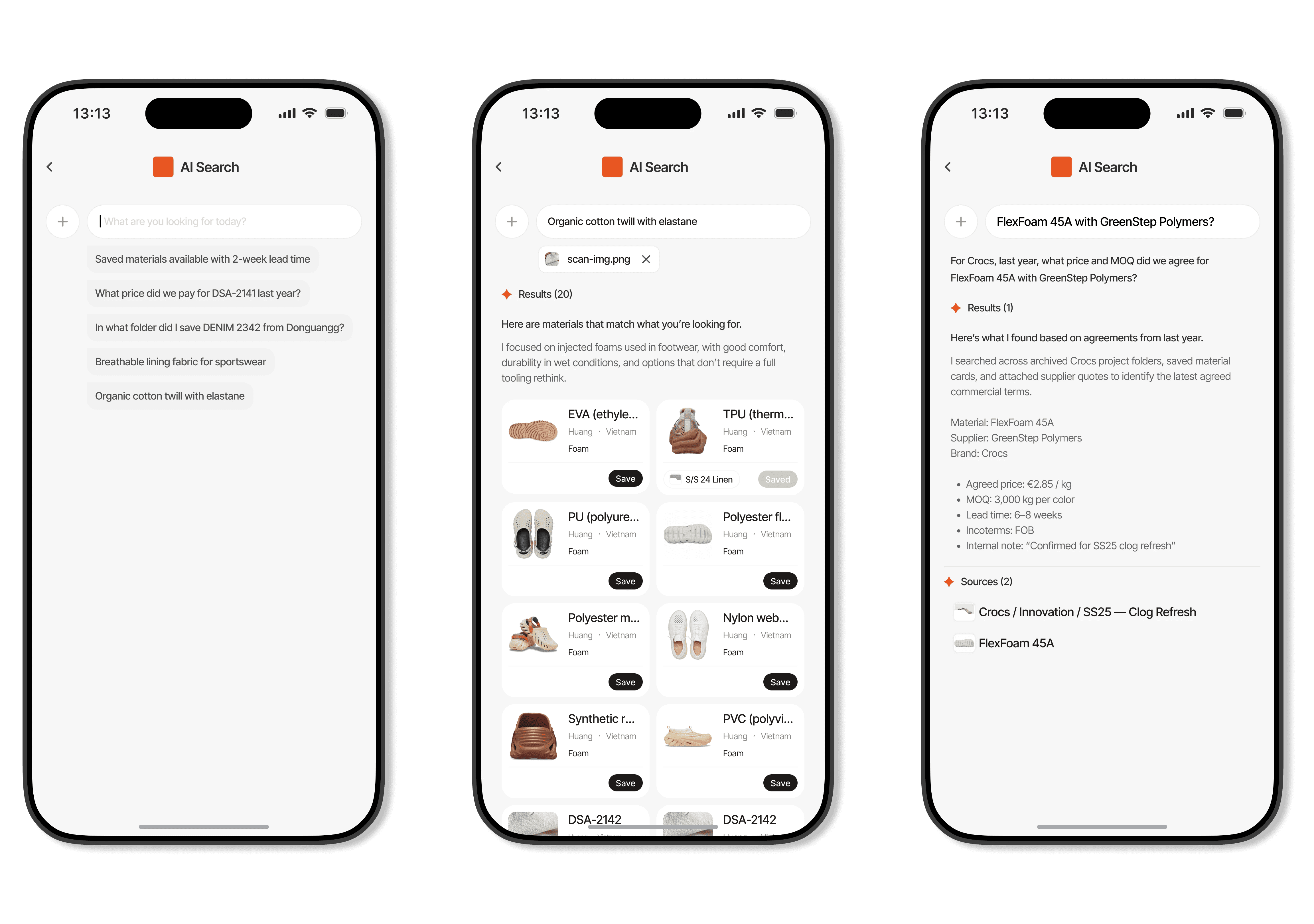
AI-powered sourcing and supplier discovery.
Users could search using: Natural language prompts, collection briefs, material characteristics or visual references.
Digitise
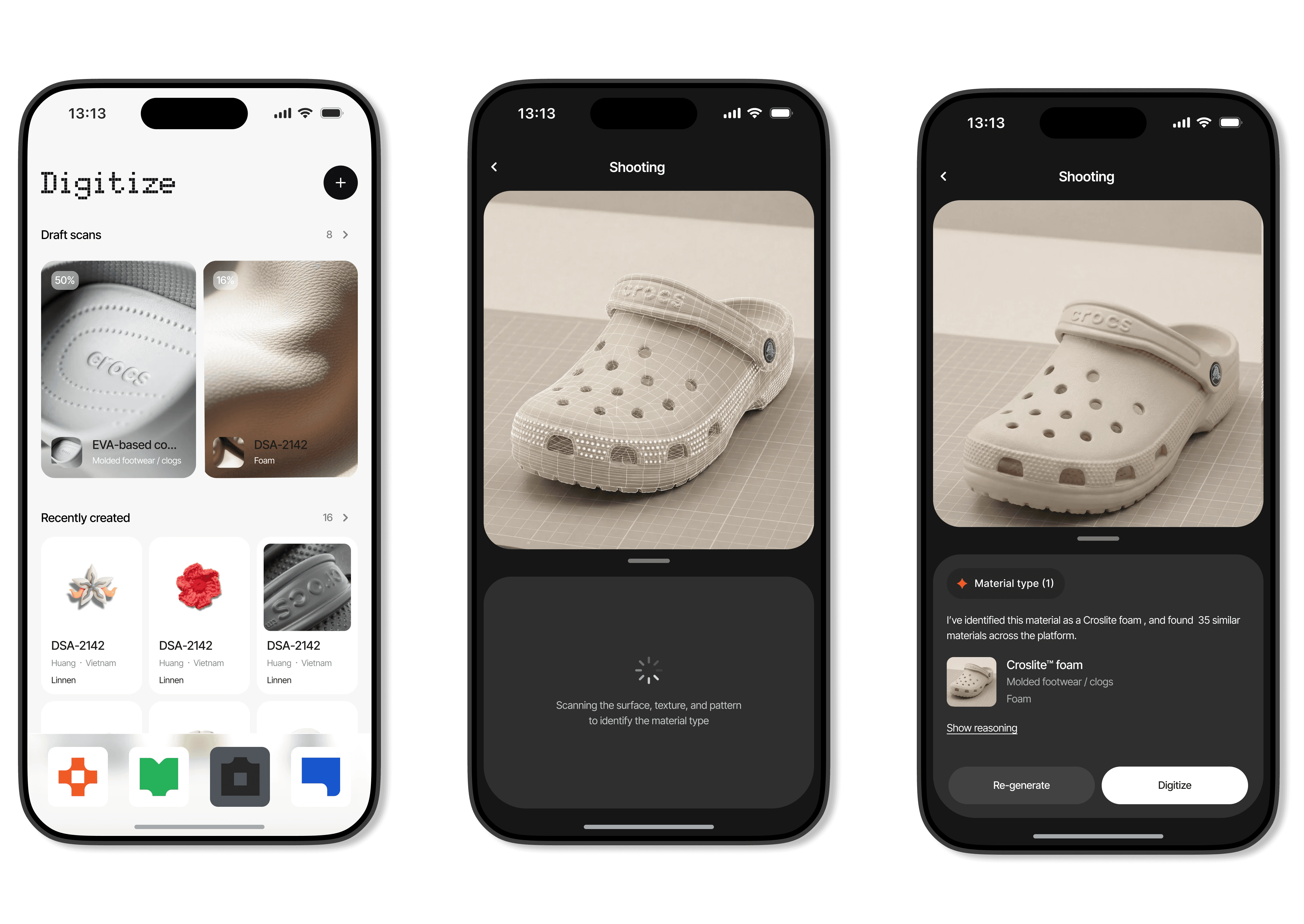
AI-assisted material digitisation and structuring.
Suppliers could scan or upload materials while AI assisted in organising and completing metadata automatically using existing material references and image recognition.
Save
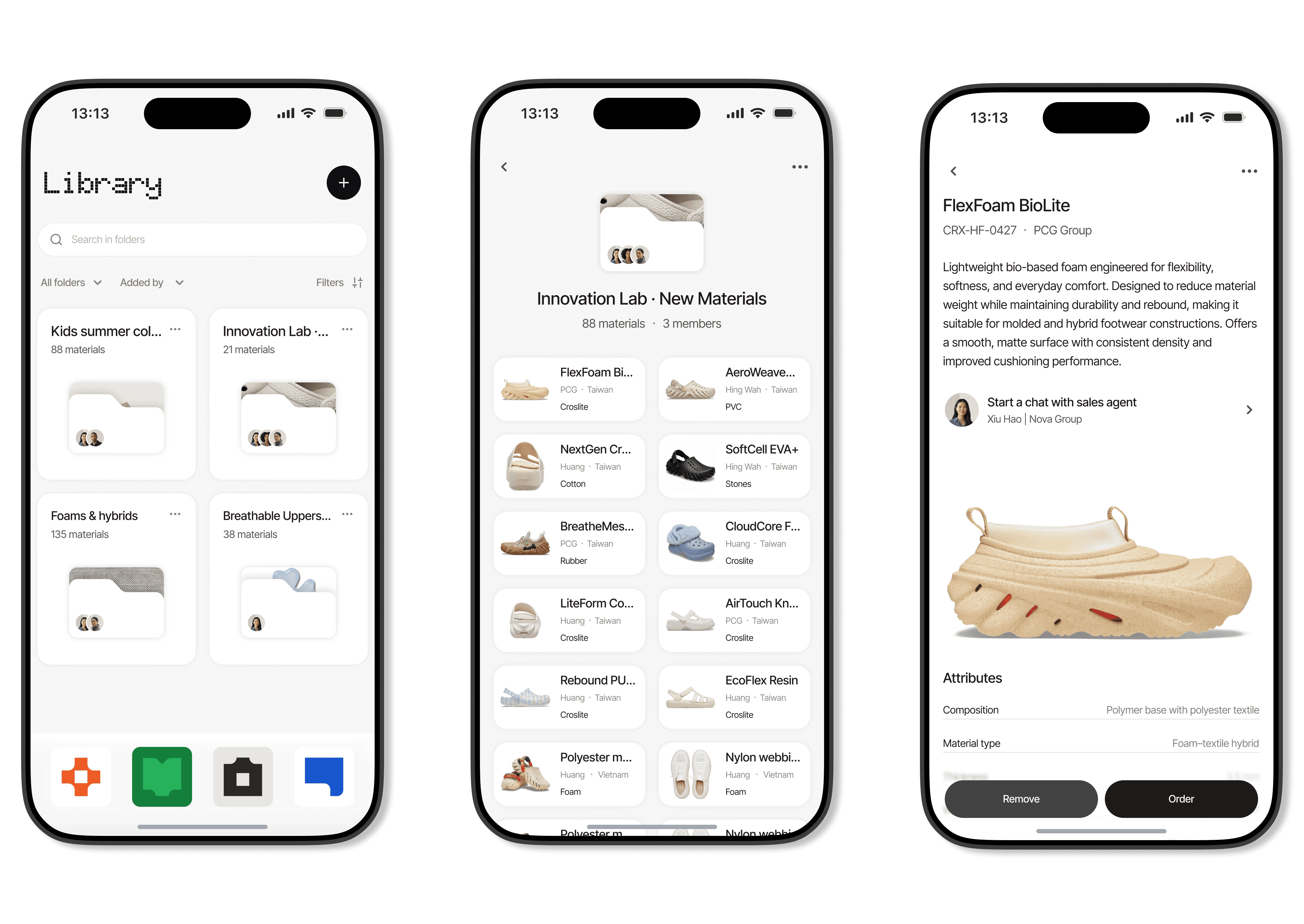
Material libraries and collection systems.
Users could: Save materials into collections, organise sourcing references, compare materials and build reusable sourcing libraries
Collaborate
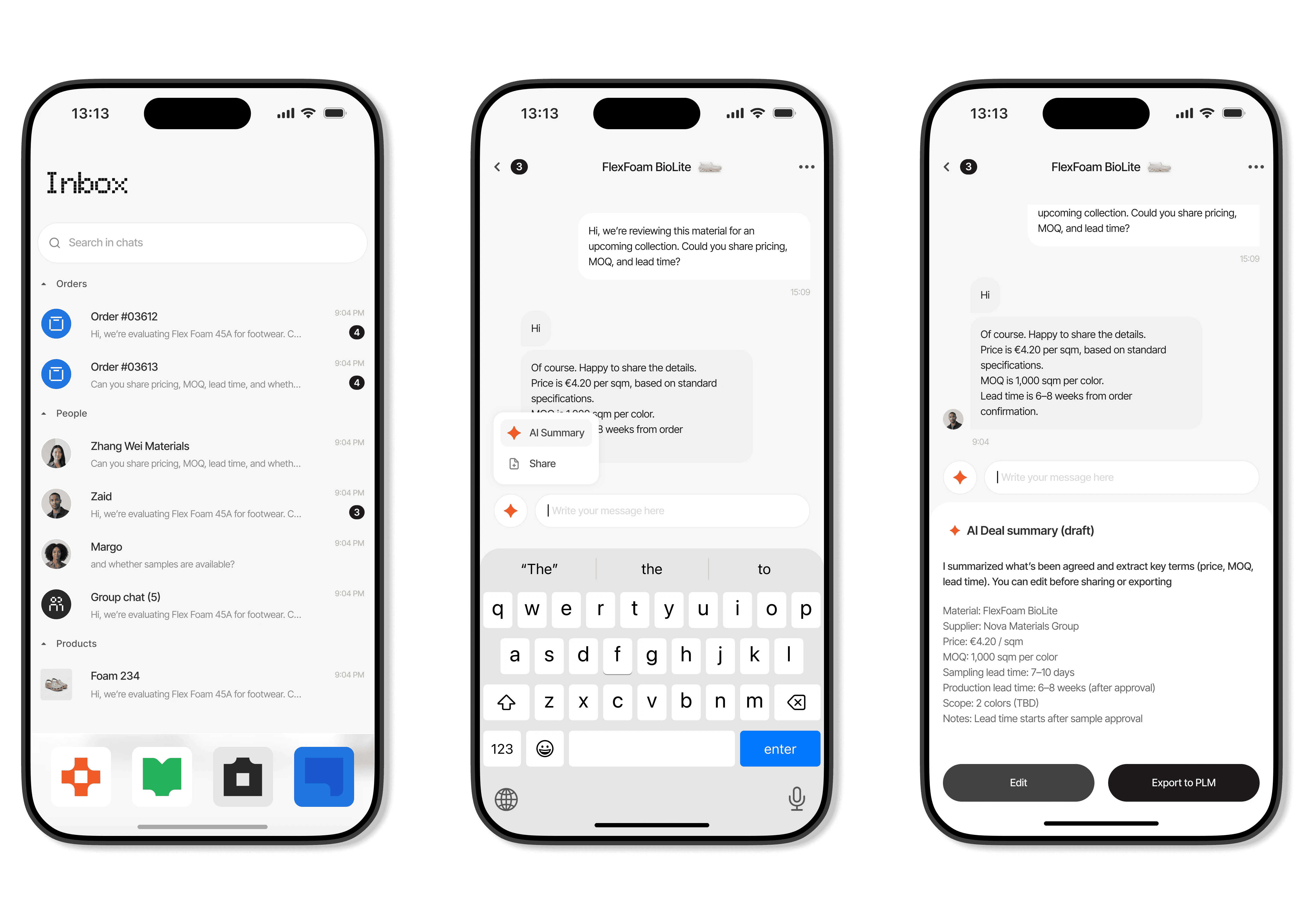
Shared workflows between brands and suppliers.
The platform centralised: Communication, orders, notifications, material requests and workflow updates.
Core Flows & Solutions
The product was shaped through a series of decisions driven by constraints, not features. Each decision focused on creating value beyond the application flow.
Smart Search & Matching
Traditional sourcing workflows relied heavily on manual filtering and supplier outreach. The search experience was redesigned around conversational and contextual inputs.
Users could describe sourcing needs naturally through:
Collection concepts
Material characteristics
Design intentions
Sustainability requirements
→ Result: faster supplier discovery and more efficient sourcing workflows.
AI-Assisted Material Digitization
Uploading materials was identified as one of the highest-friction actions across the platform. The flow was designed to minimise repetitive tasks while maintaining user control and verification.
To reduce manual work, AI-assisted flows were introduced to:
Detect material attributes
Pre-fill metadata
Reuse information from previous uploads
Structure unorganised input data
→ Result: faster onboarding and improved data consistency across supplier catalogs.
Library & Collection Management
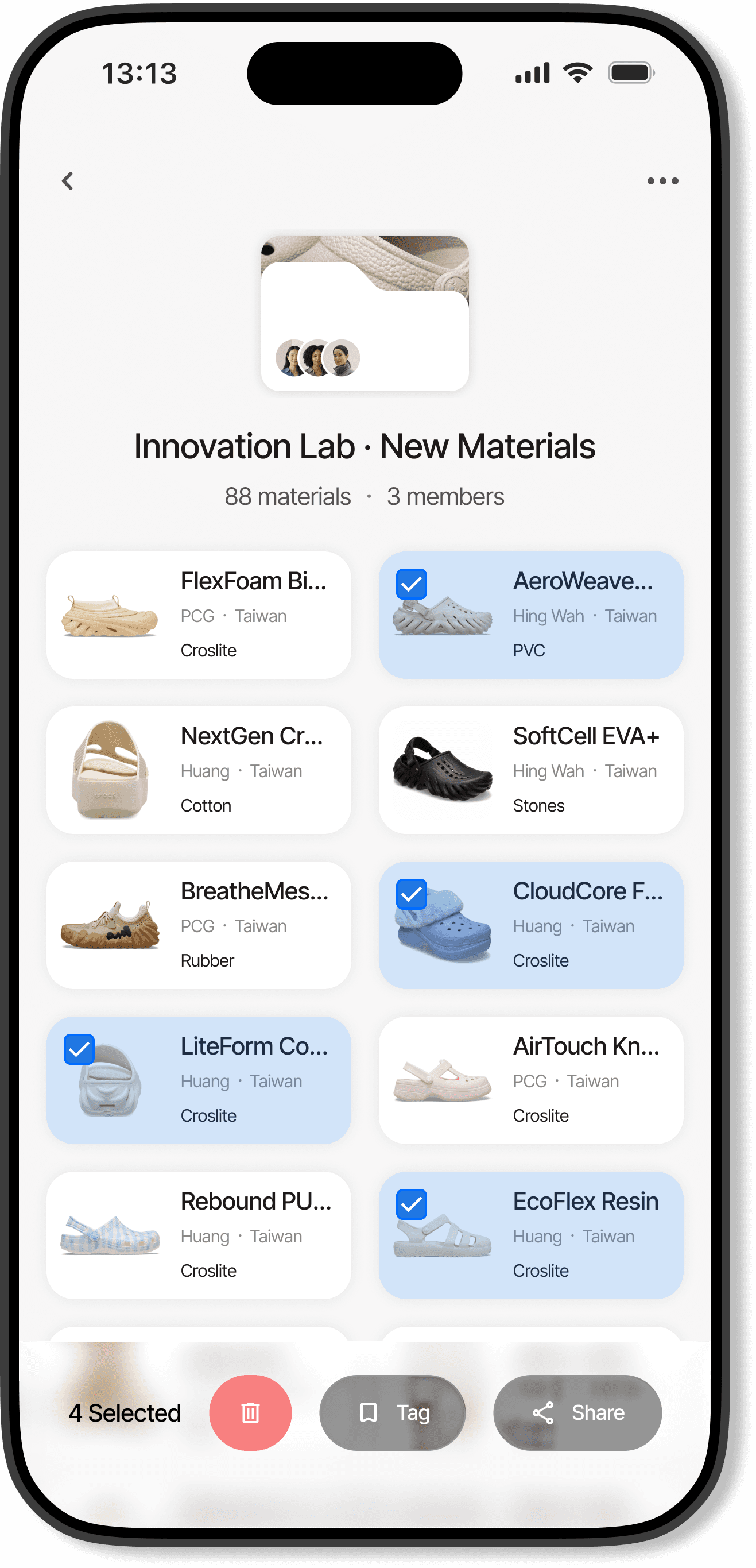
Material sourcing often generates fragmented references and disconnected information. Different organisational systems were created for brands and suppliers depending on workflow needs.
The platform introduced centralised libraries where users could:
Save materials into collections
Organise and categorise materials
Share and collaborate with team members or other user types.
→ Result: reduced fragmentation and improved continuity across sourcing cycles.
Continuous Sourcing Workflow
The platform connected the full sourcing lifecycle into a continuous workflow. Rather than existing as isolated tools, all interactions remained connected to the platform.
Material discovery
Supplier communication
Material requests
Order management
Notifications and updates
→ Result: improved visibility and reduced dependency on external communication channels.
AI-Assisted Orders & Communication
Order management traditionally involved repetitive communication and manual follow-ups.
AI-assisted workflows helped summarise and keep track. This reduced operational overhead while improving information accessibility across conversations and workflows.
Orders
Requests
Supplier updates
Notifications
→ Result: more efficient communication and improved workflow clarity.
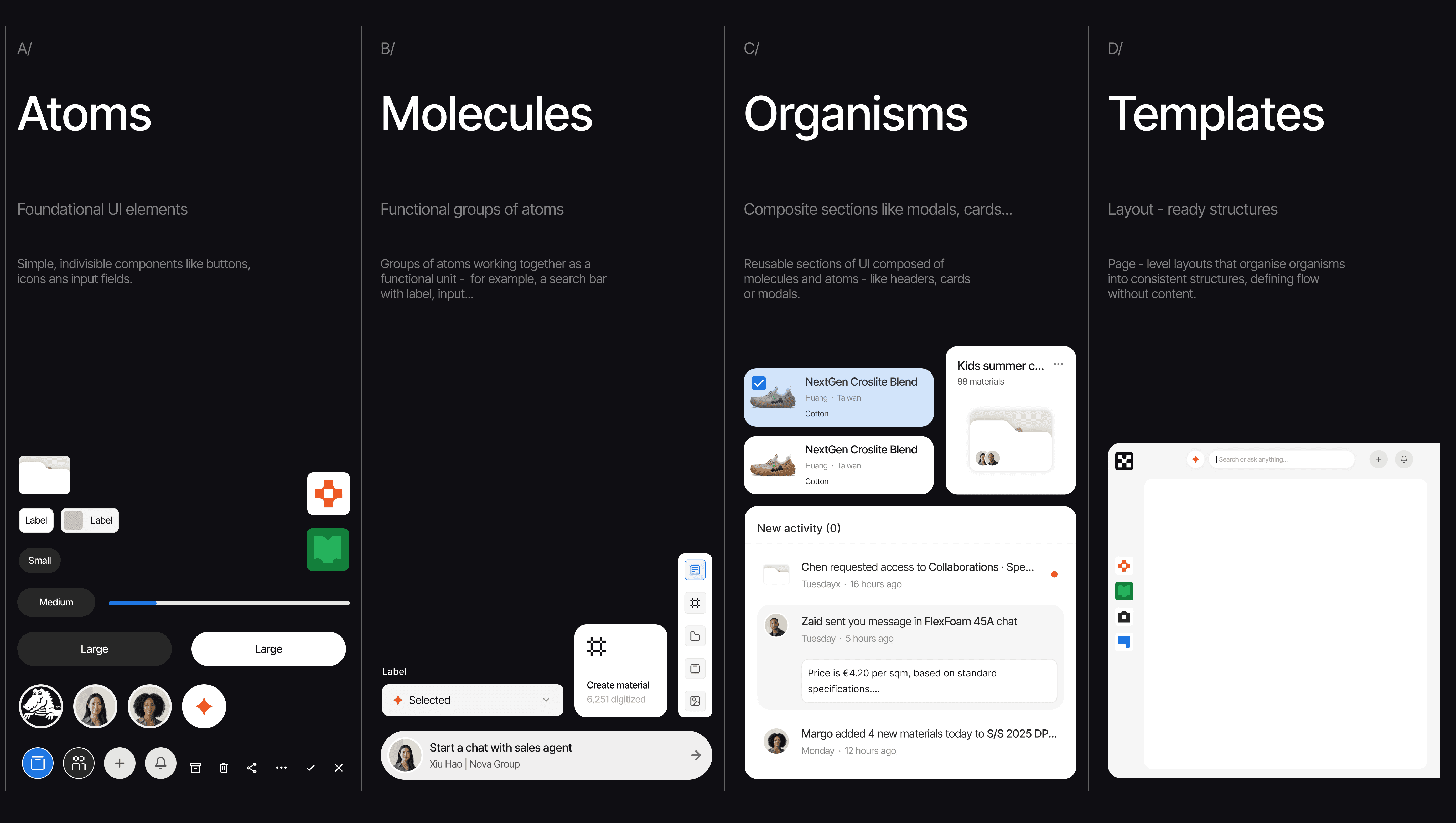
Design System
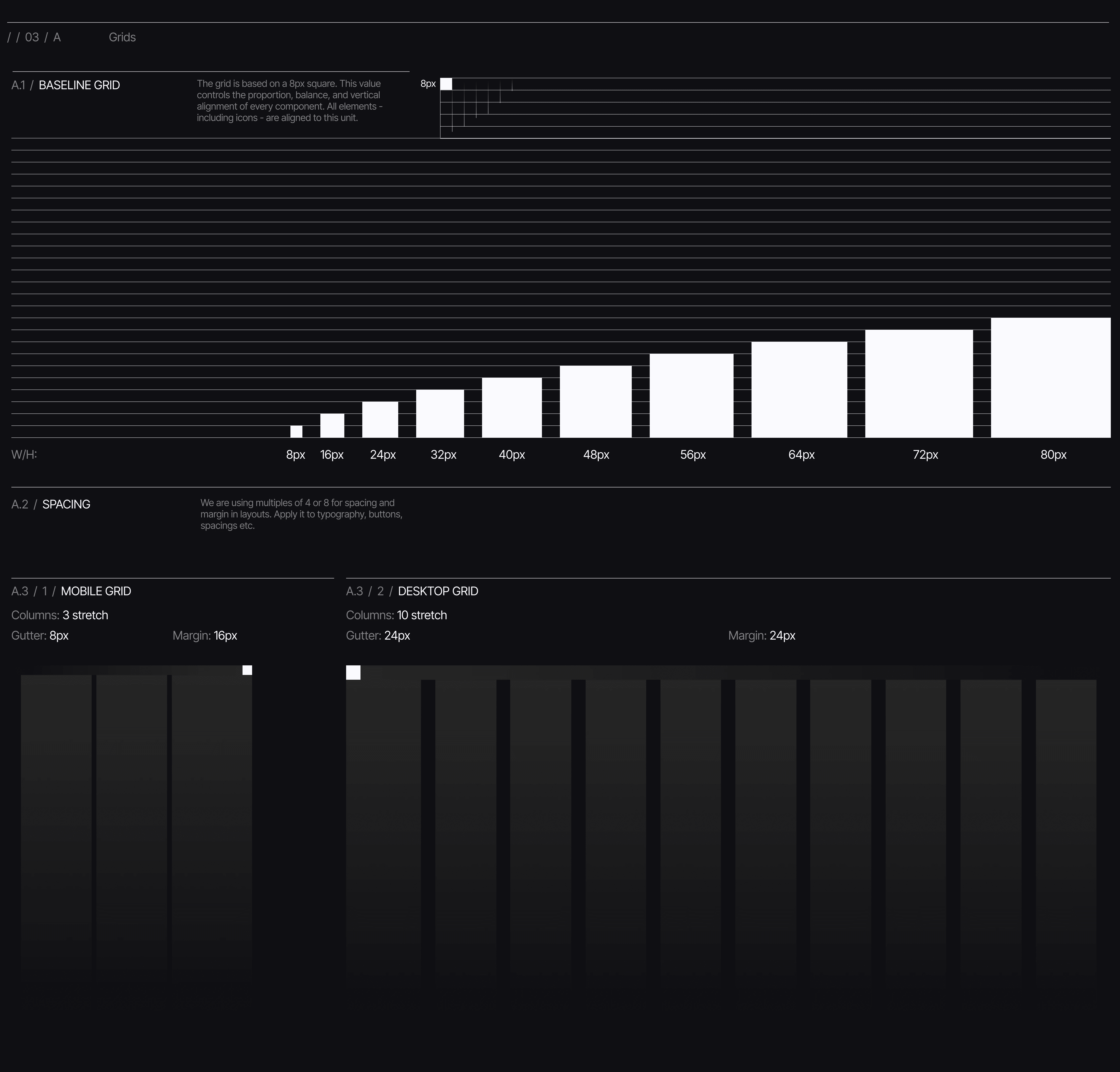
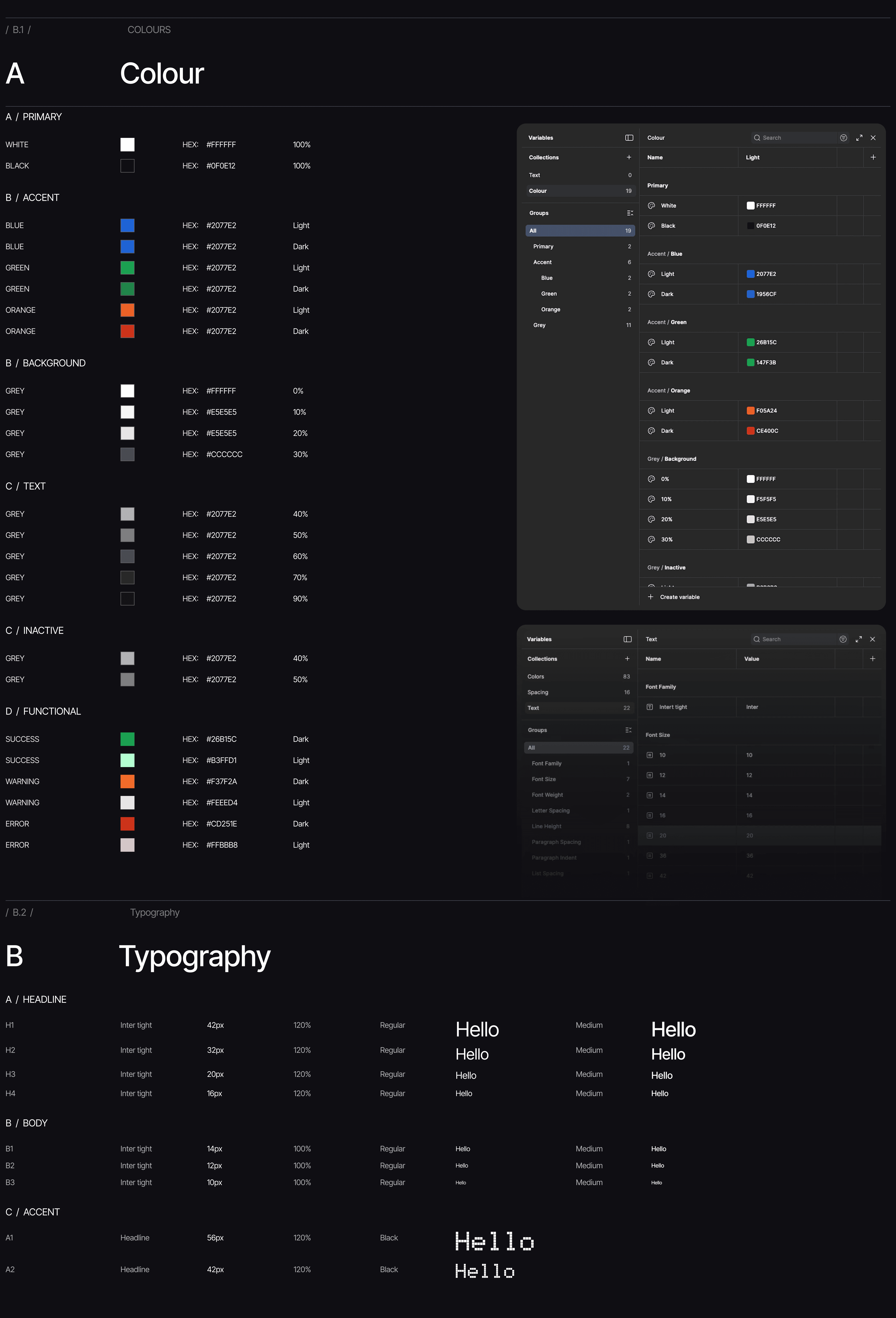
As the platform expanded, consistency and scalability became critical. A new design system was created to unify the experience across the ecosystem.
01 — Grids
02 — Tokens & Variables
03 — Components
04 — Design System Elements



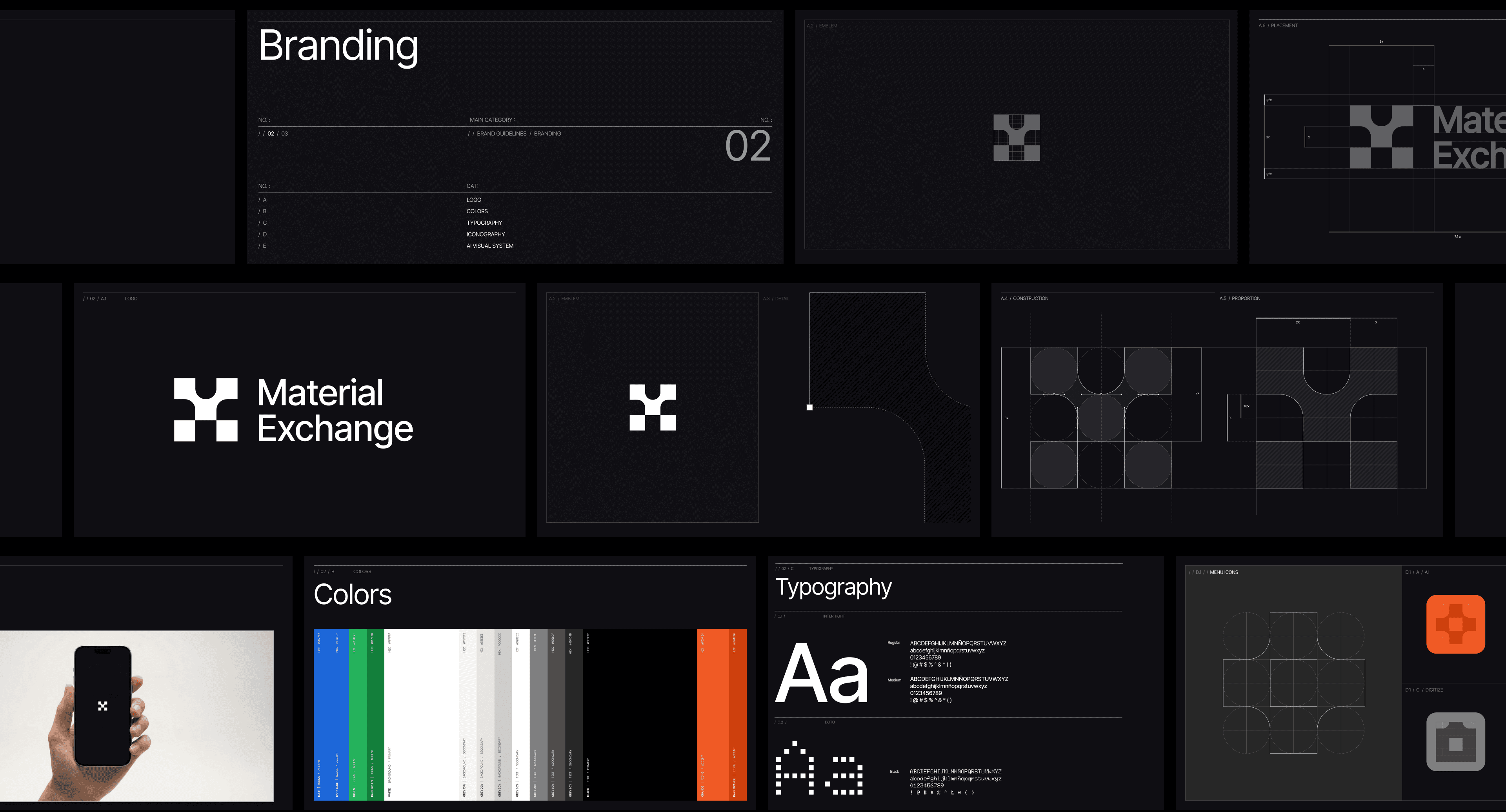
Brand & Visual Language
The visual identity was redesigned to position the platform as a more contemporary and intelligent product ecosystem.
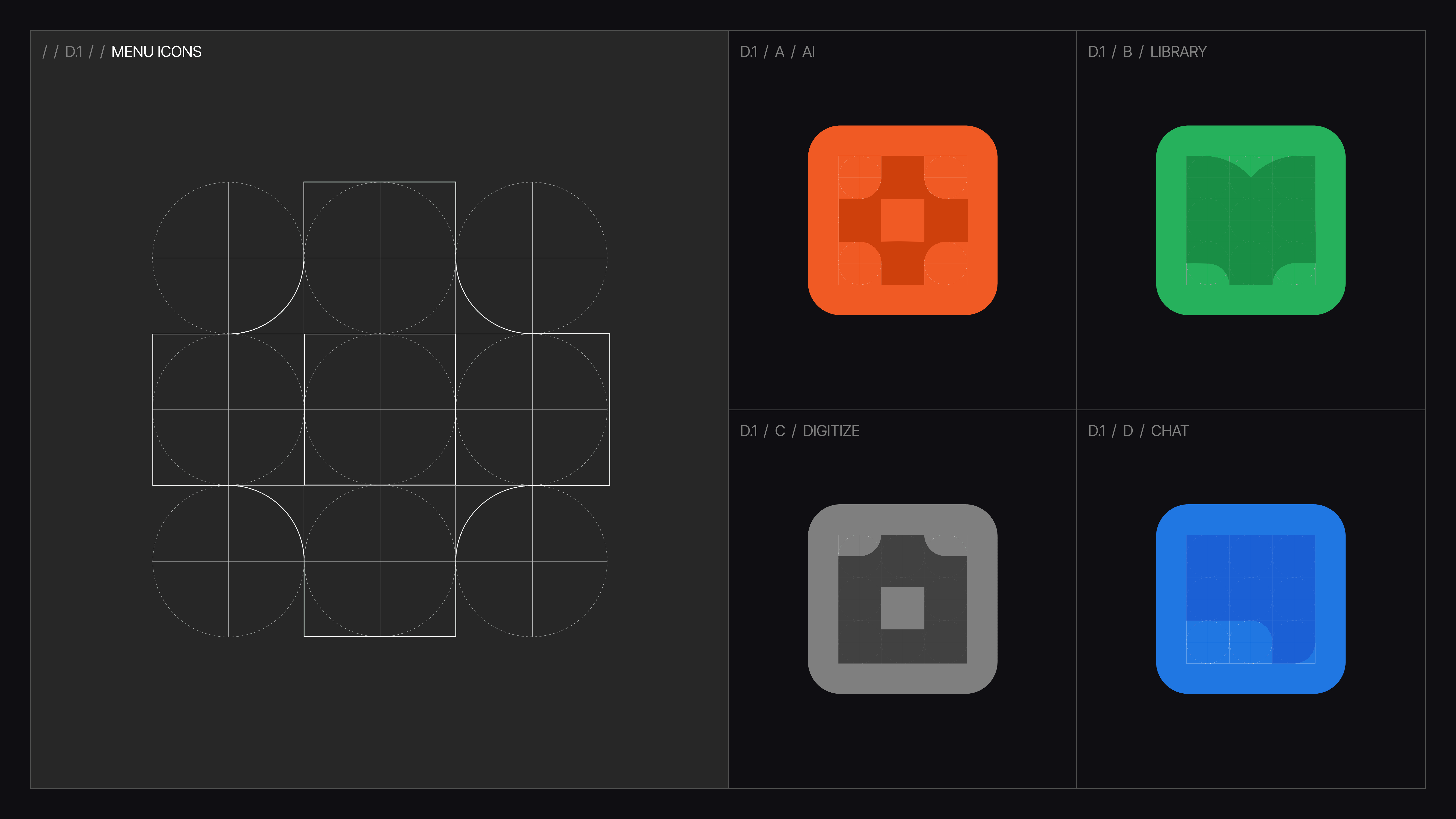
Iconography
Built as a functional system, not a collection of symbols. Each icon is constructed on a strict grid, using simple geometric primitives and pixel-based logic.
Inspired by classic interface iconography and early digital systems, the shapes reference pixel art → not as nostalgia, but as a way to express precision, structure, and intent.
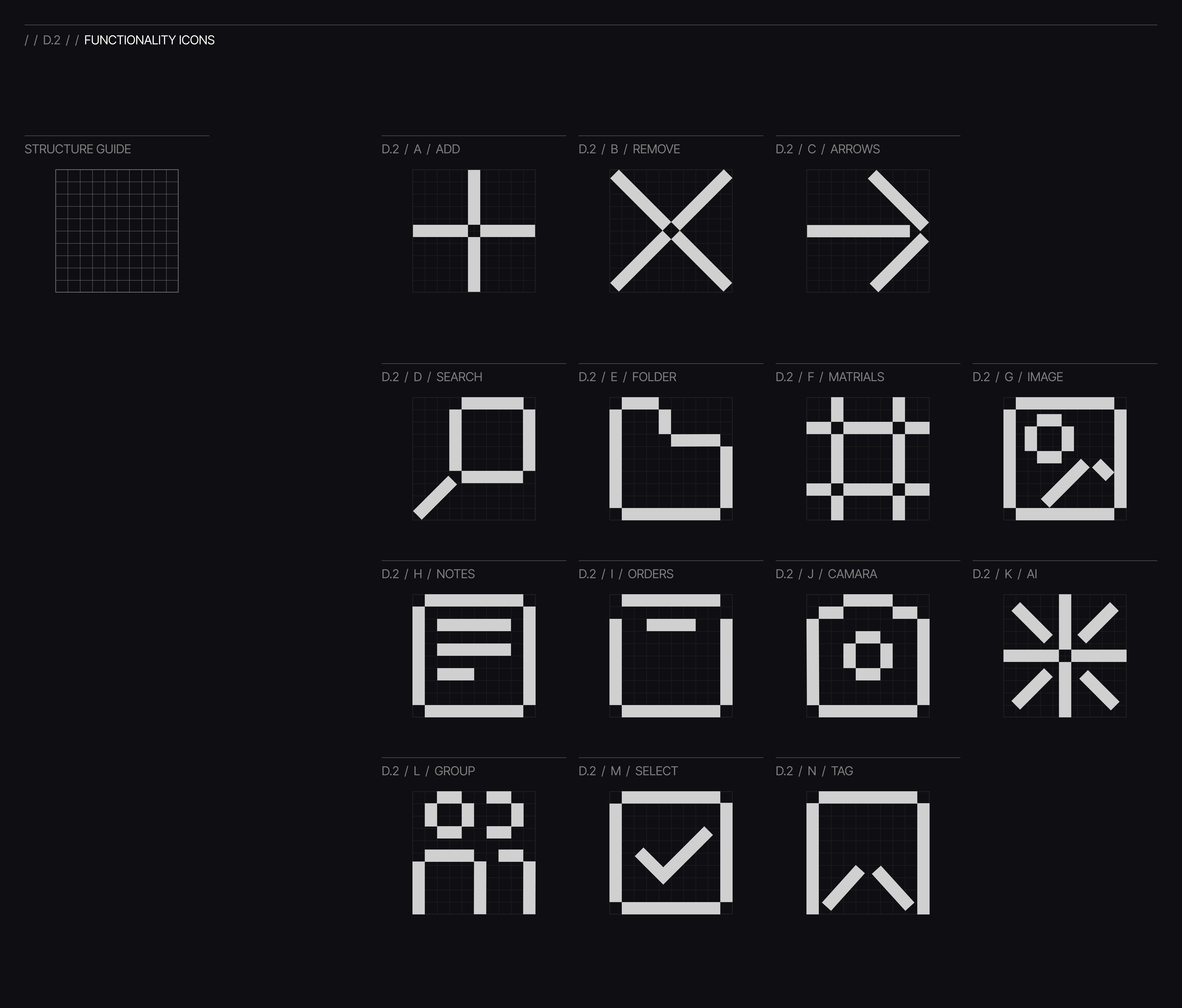
Digital-first expression
→ The pixel influence reinforces clarity and legibility at small sizes, while giving the icons a precise, computational feel that reflects the product’s AI foundation.
Grid-driven construction
→ All icons are built on the same underlying grid. This ensures consistency, scalability, and visual rhythm across the system.
AI visual sytem
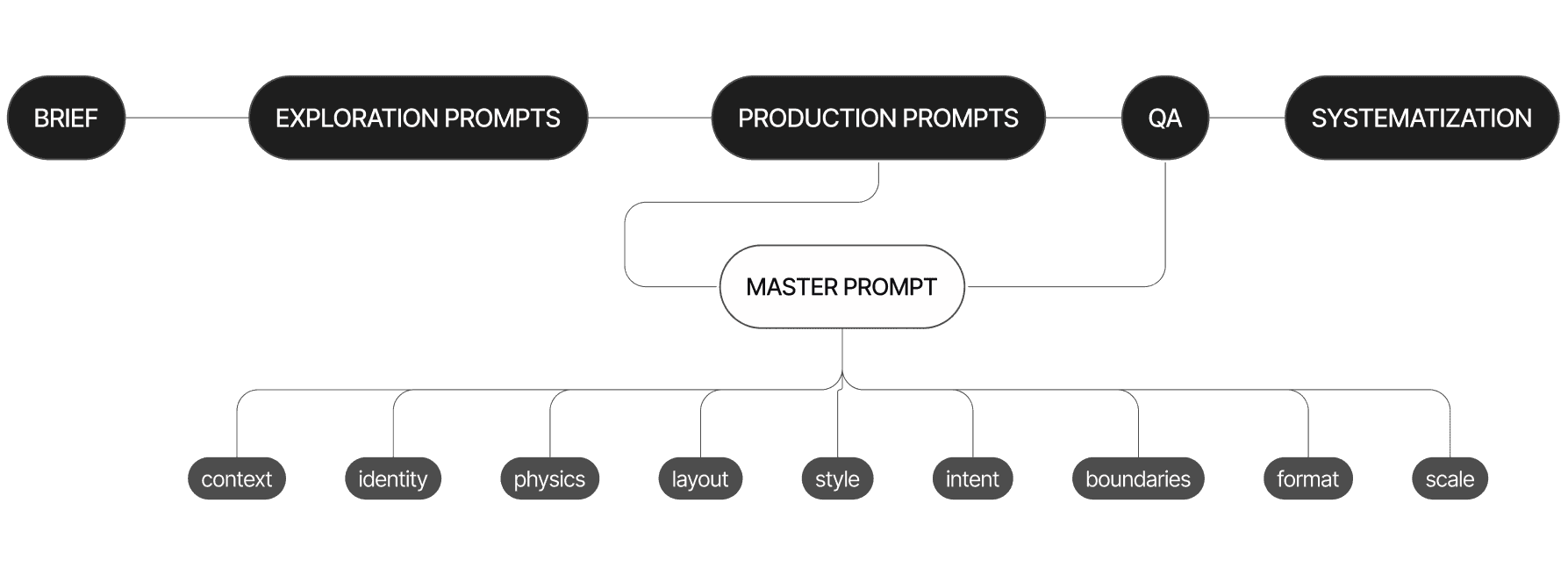
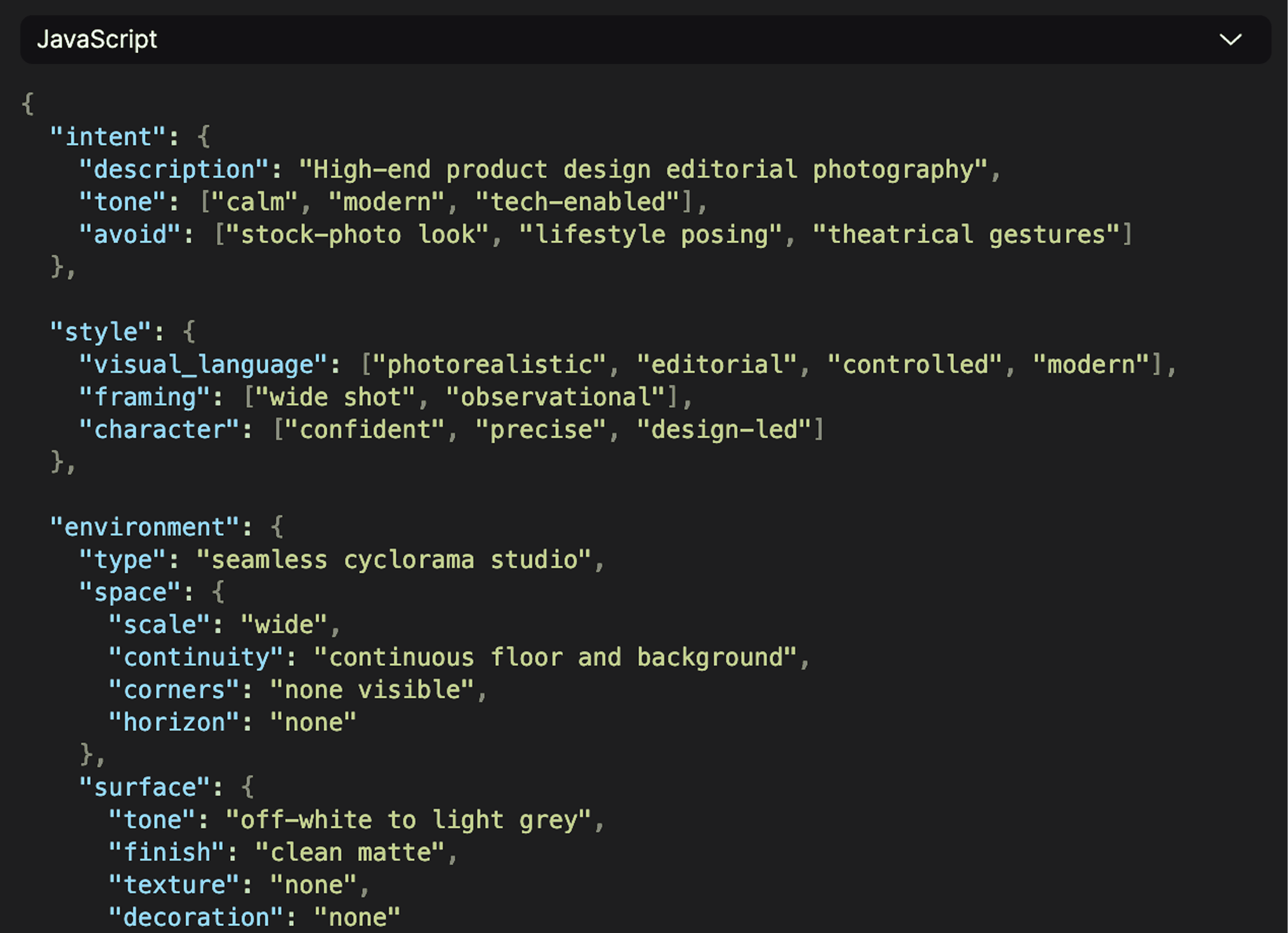
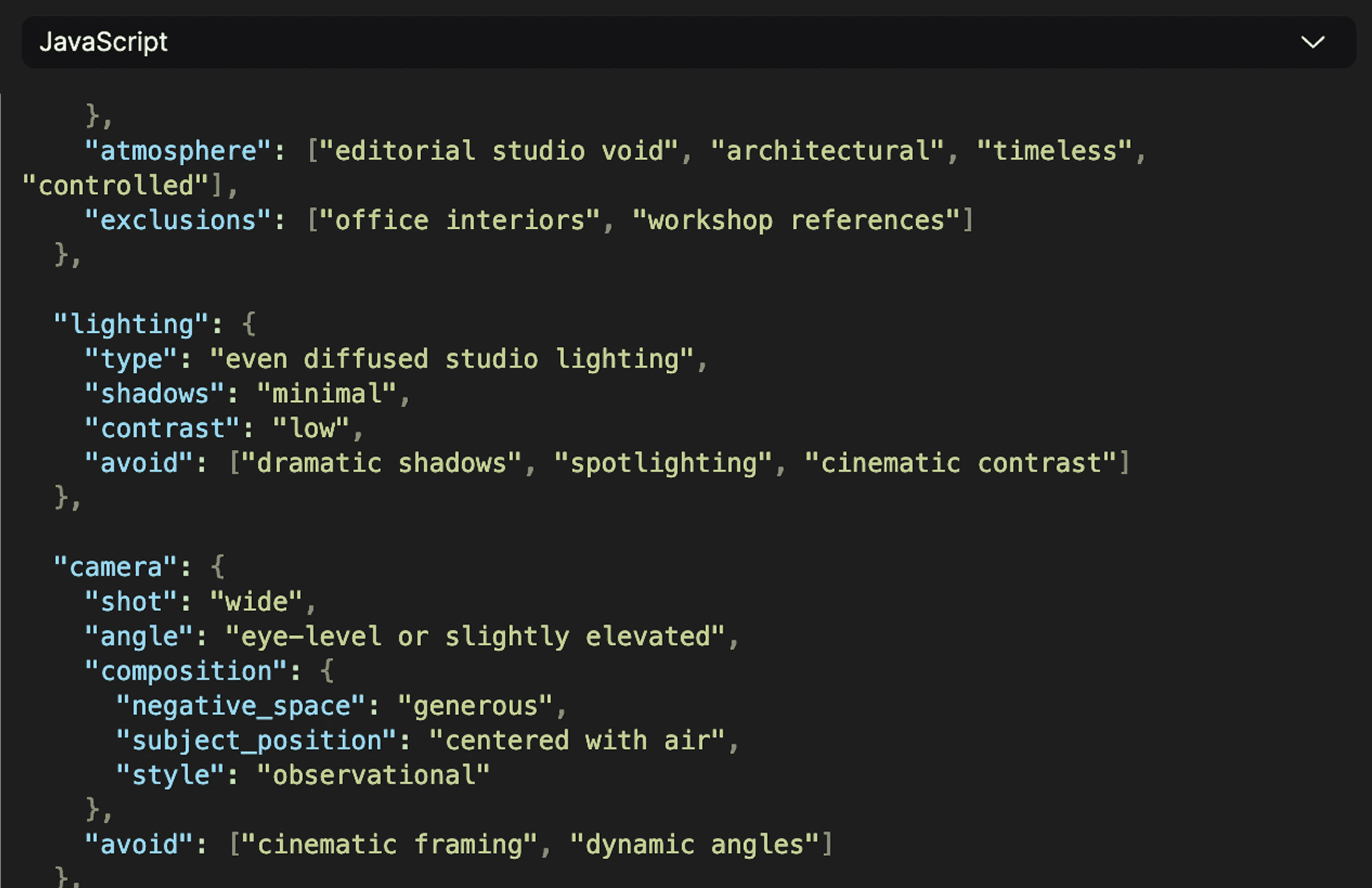
As part of our creative workflow, we use prompt design as a tool to define and test the visual direction of the product and brand. Instead of starting from static references, we built a structured prompt system to generate assets that helped visualise what Material Exchange is, who it is for, and the problems it solves.

Outcome
The project established a more scalable and coherent foundation for the platform.
Unified workflows across multiple user types
Scalable design and component systems
Improved sourcing and communication flows
Validation of AI-assisted operational workflows
Clearer product structure and positioning
Despite funding and operational challenges, the project demonstrated the potential of a centralized, AI-assisted sourcing ecosystem within the textile industry.
Reflection
The challenge was not simply creating interfaces, but defining how the platform could provide value despite its limitations.
Material Exchange highlighted the complexity of designing systems within industries that still operate through fragmented and highly manual processes.
One of the main lessons was that design can function not only as interface execution, but as a tool for product definition and strategic alignment.
The project also reinforced several key principles:
Multi-sided platforms require strong system-level thinking
Flexibility is essential when workflows differ across organisations
AI is most effective when embedded naturally into operational tasks
Scalable systems depend as much on structure and clarity as on visual design
Ultimately, the project became less about designing screens, and more about creating a shared operational language across a complex ecosystem.
Overview
Material Exchange is a B2B platform for the textile supply chain, connecting brands, suppliers, and manufacturers within a shared ecosystem for sourcing, collaboration, and production management.
The platform was designed to centralise workflows that traditionally happen across fragmented tools such as emails, spreadsheets, PDFs, and disconnected supplier databases. By combining AI-assisted workflows with structured material data, Material Exchange aimed to reduce operational friction and improve sourcing efficiency across the industry.
Role
UI Product Designer. Contributing in restructuring and evolution of the platform, focusing on product clarity, scalability, and system consistency across multiple user types.
Deliverables
End-to-end UI redesign
Product architecture definition
Design system
Core user flows
AI-assisted workflow design
Brand & visual system
Prototypes and validation flows
Tools
Figma
Figma Make
Adobe Creative Suite
Timeline
02/2025 -
02/2026
Credits
Juan Sisinni [Product Lead Designer]
Samuel Lazslo [Product Owner]
Andranik Antonyan [Full Stack Engineer]
Mher Sargsyan [Full Stack Engineer]
David Vojnic Hajduk [Frontend developer]
Borko Mihajlovic [Full Stack Engineer]
Maja Horvacki [Frontend developer]
Csaba Korponai [Senior Backend Engineer]
Dijana Gabric [Backend Engineer]
Timeline
2.5 years
Tools
Figma
Adobe Creative Suite
Deliverables
0→1 MVP
Product Definition
Information Architecture
Interaction Design
UX/UI Design
Design Systems
Creative Direction
Credits
Juan Sisinni [Product Designer]
Miguel González [Product Manager]
Marcus Stenbeck [Full Stack Engineer]
Cristina Fresneda [Full Stack Engineer]
Joaquin Castañeda [Graphic Designer]
Role
UI Designer
Contributing to product structure, feature definition, system scalability, and visual identity.
The-Problem_01
The textile sourcing industry operates through highly fragmented workflows.
At the same time, increasing pressure around speed, sustainability, and traceability requires more structured and intelligent workflows.
Material Exchange was designed to transform sourcing from a fragmented, transactional process into a continuous, data-driven system.
Product-Positioning_02
Material Exchange acts as a shared intelligence layer across the supply chain.
Rather than functioning as a simple marketplace, the platform connects sourcing, communication, material data, and supplier relationships into a continuous ecosystem.
The platform transforms:
Sourcing from Transactional → Continuous
Material data from Static → Reusable
Communication from Fragmented → Centralised
Supplier discovery from Manual → Intelligent
Key-Problems_03
The core challenge was not only designing interfaces, but defining a scalable system under uncertainty.
Material Exchange was already an established startup with active industry relationships and a growing product ecosystem. However, the platform lacked a clearly unified product direction.
Fragmented workflows
→ Material sourcing relied on disconnected tools and repetitive communication.
High friction in data input
→ Suppliers struggled with time-consuming and inconsistent material uploads.
Fragmented workflows
→ Material sourcing relied on disconnected tools and repetitive communication.
Lack of shared system logic
→ Different processes across companies made standardiSation difficult.
Designing-a-Multi-Sided System_04
The platform supports three primary user types:
The challenge was aligning these different mental models within a single, coherent system.
The solution balanced:
Flexibility → to accommodate different workflows
Standardisation → to maintain consistency and scalability
Product-Architecture_05
Search
AI-powered sourcing and supplier discovery.
Users could search using: Natural language prompts, collection briefs, material characteristics or visual references.
Digitise
AI-assisted material digitisation and structuring.
Suppliers could scan or upload materials while AI assisted in organising and completing metadata automatically using existing material references and image recognition.
Save
Material libraries and collection systems.
Users could: Save materials into collections, organise sourcing references, compare materials and build reusable sourcing libraries
Collaborate
Shared workflows between brands and suppliers.
The platform centralised: Communication, orders, notifications, material requests and workflow updates.
Core-Flows-and-Solutions_06
The product was shaped through a series of decisions driven by constraints, not features. Each decision focused on creating value beyond the application flow.
Smart Search & Matching
Traditional sourcing workflows relied heavily on manual filtering and supplier outreach. The search experience was redesigned around conversational and contextual inputs.
Users could describe sourcing needs naturally through:
Collection concepts
Material characteristics
Design intentions
Sustainability requirements
→ Result: faster supplier discovery and more efficient sourcing workflows.
AI-Assisted Material Digitization
Uploading materials was identified as one of the highest-friction actions across the platform. The flow was designed to minimise repetitive tasks while maintaining user control and verification.
To reduce manual work, AI-assisted flows were introduced to:
Detect material attributes
Pre-fill metadata
Reuse information from previous uploads
Structure unorganised input data
→ Result: faster onboarding and improved data consistency across supplier catalogs.
Library & Collection Management
Material sourcing often generates fragmented references and disconnected information. Different organisational systems were created for brands and suppliers depending on workflow needs.
The platform introduced centralised libraries where users could:
Save materials into collections
Organise and categorise materials
Share and collaborate with team members or other user types.
→ Result: reduced fragmentation and improved continuity across sourcing cycles.
Continuous Sourcing Workflow
The platform connected the full sourcing lifecycle into a continuous workflow. Rather than existing as isolated tools, all interactions remained connected to the platform.
Material discovery
Supplier communication
Material requests
Order management
Notifications and updates
→ Result: improved visibility and reduced dependency on external communication channels.
AI-Assisted Orders & Communication
Order management traditionally involved repetitive communication and manual follow-ups.
AI-assisted workflows helped summarise and keep track. This reduced operational overhead while improving information accessibility across conversations and workflows.
Orders
Requests
Supplier updates
Notifications
→ Result: more efficient communication and improved workflow clarity.
Design-System_07
As the platform expanded, consistency and scalability became critical. A new design system was created to unify the experience across the ecosystem.
01 — Grids
02 — Tokens & Variables
03 — Components
04 — Design System Elements
Brand-Visual-Language_08
The visual identity was redesigned to position the platform as a more contemporary and intelligent product ecosystem.
Iconography_09
Built as a functional system, not a collection of symbols. Each icon is constructed on a strict grid, using simple geometric primitives and pixel-based logic.
Inspired by classic interface iconography and early digital systems, the shapes reference pixel art → not as nostalgia, but as a way to express precision, structure, and intent.
Digital-first expression
→ The pixel influence reinforces clarity and legibility at small sizes, while giving the icons a precise, computational feel that reflects the product’s AI foundation.
Grid-driven construction
→ All icons are built on the same underlying grid. This ensures consistency, scalability, and visual rhythm across the system.
AI-visual-sytem_10
As part of our creative workflow, we use prompt design as a tool to define and test the visual direction of the product and brand. Instead of starting from static references, we built a structured prompt system to generate assets that helped visualise what Material Exchange is, who it is for, and the problems it solves.
Outcome_11
The project established a more scalable and coherent foundation for the platform.
Unified workflows across multiple user types
Scalable design and component systems
Improved sourcing and communication flows
Validation of AI-assisted operational workflows
Clearer product structure and positioning
Despite funding and operational challenges, the project demonstrated the potential of a centralized, AI-assisted sourcing ecosystem within the textile industry.
Reflection_12
The challenge was not simply creating interfaces, but defining how the platform could provide value despite its limitations.
Material Exchange highlighted the complexity of designing systems within industries that still operate through fragmented and highly manual processes.
One of the main lessons was that design can function not only as interface execution, but as a tool for product definition and strategic alignment.
The project also reinforced several key principles:
Multi-sided platforms require strong system-level thinking
Flexibility is essential when workflows differ across organisations
AI is most effective when embedded naturally into operational tasks
Scalable systems depend as much on structure and clarity as on visual design
Ultimately, the project became less about designing screens, and more about creating a shared operational language across a complex ecosystem.
Julia Martí / juliamarti.es
©
2019-2026
ლ(ಠ益ಠლ
Julia Martí / juliamarti.es
©
2019-2026
ლ(ಠ益ಠლ
Julia Martí / juliamarti.es
©
2019-2026
ლ(ಠ益ಠლ