Overview
Designing a behavioural finance app that transforms impulse shopping into intentional decision-making.
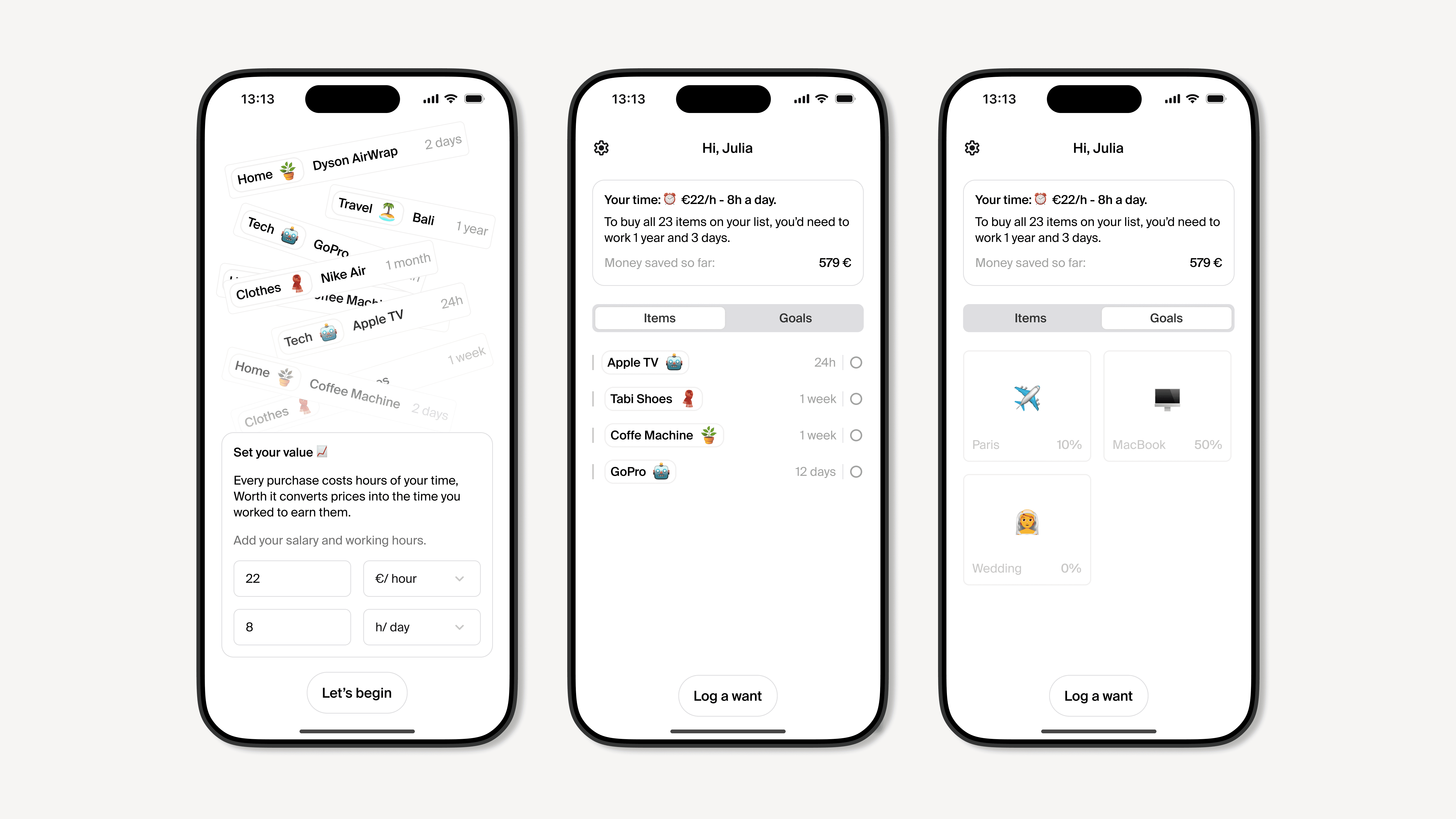
Instead of focusing on budgeting after money is spent, the product focuses on the emotional and psychological moment before spending happens.
Users save products they want to buy, pause the decision, and over time decide whether to: buy the item, postpone it, abandon it or convert that money into progress toward personal goals
The product explores a simple idea: If people create distance between desire and action, they make better financial decisions.
Built using AI-assisted development tools, the project serves as both a functional prototype and an experiment in prompt-driven workflows, testing how structured inputs can shape product logic, user experience, and system behaviour.
Role
Founding Product Designer
Deliverables
0→1 MVP
Product Strategy
UX/UI Design
"Vide coding" 💅
Tools
Figma
Claude.ai
Replit
Timeline
01/02/2026 - 30/03/2026
The Problem
Shopping has become frictionless. Everything in modern commerce is optimized for immediacy.
The result is that many purchases happen emotionally instead of intentionally. People often buy things because of boredom, stress, dopamine, insecurity, aspiration or trend influence.
But almost none address the actual decision-making process behind spending. I wasn’t interested in designing another finance dashboard.
Key Decisions
Every part of the product is the result of a deliberate trade-off. Not what could be built, but what "should" exist to support better decisions.
Wants > budgets
Users don’t open the app to check budgets. They open it when they desire something.
→ The product starts from real behavior, not imposed structure.
Friction is a feature
Skipping an item is the action that creates value.
→ The system rewards restraint, not activity.
No dashboards
No categories, no analytics, no breakdowns.
→ The system rewards restraint, not activity.
Goals come later
Instead of forcing users to define a goal upfront:
→ Goals are built from accumulated skipped purchases.
Tests and validation
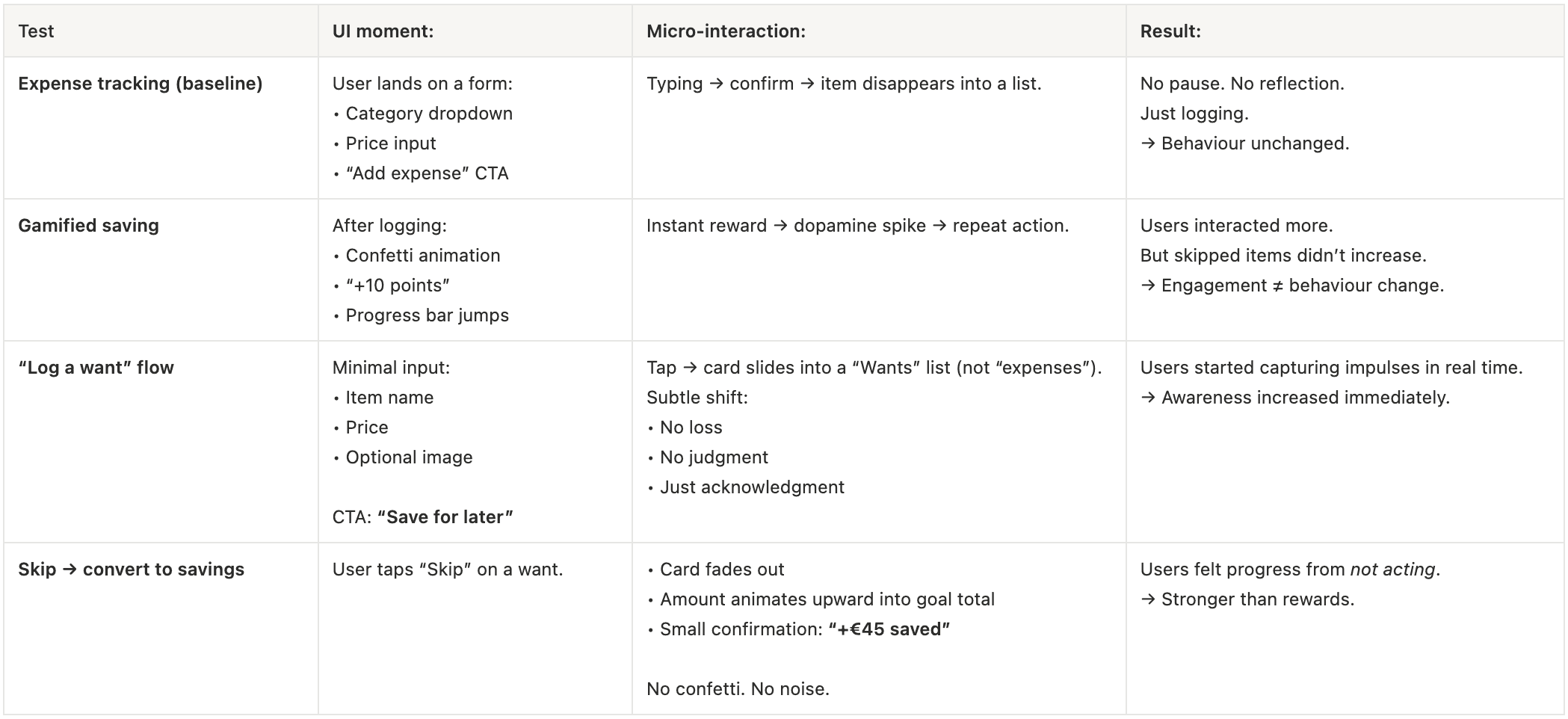
Assumptions were tested through simple, focused interactions. Each iteration explored how users behave at the moment of desire and what actually shifts that behavior.
The Process
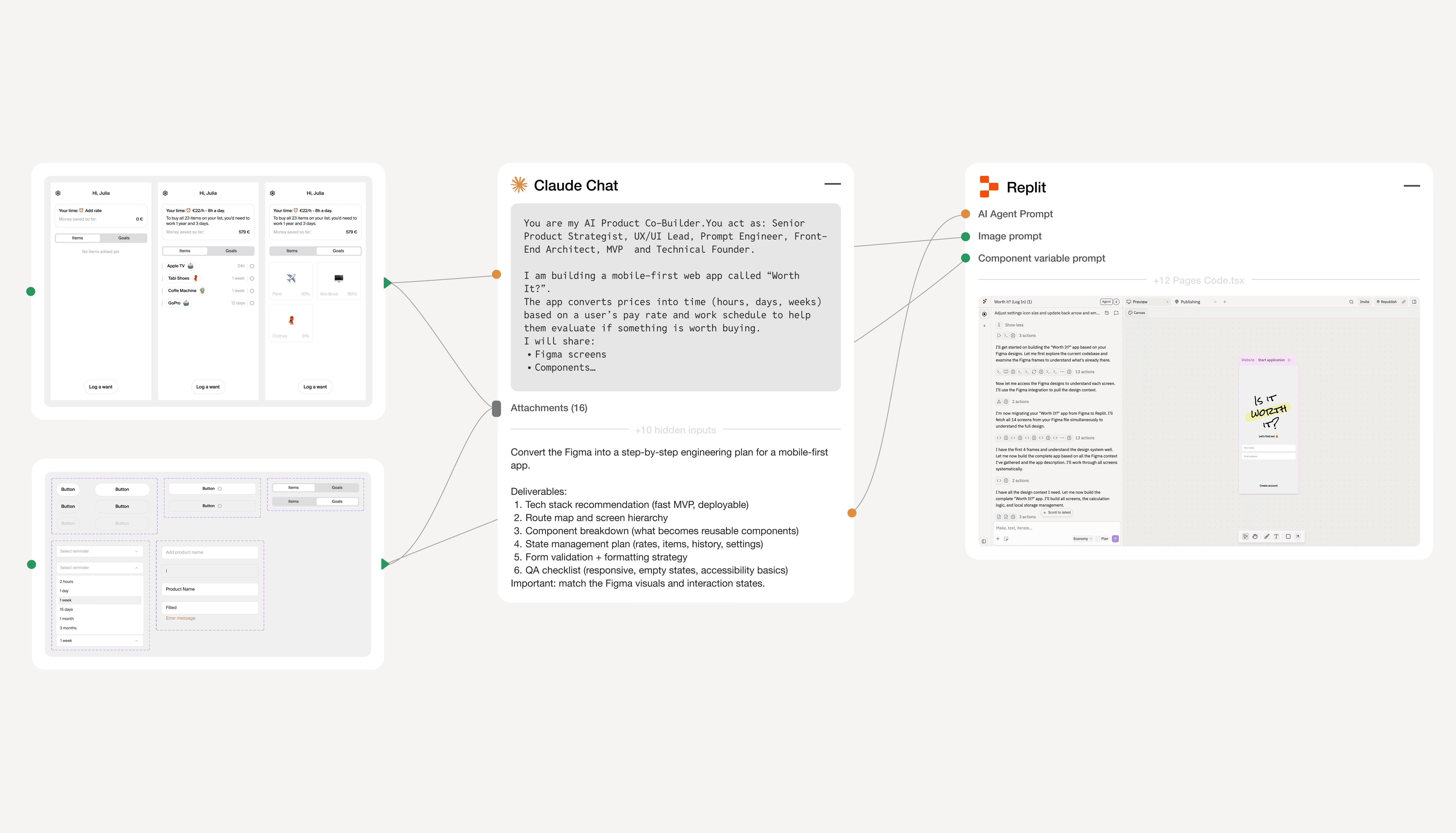
Worth It? was developed through a highly iterative workflow that combined traditional product design thinking with AI-assisted prototyping.
Rather than separating strategy, UX, UI, and implementation into isolated phases, the project evolved through continuous experimentation between:
ideation
interface design
behavioral systems thinking
prompt engineering
live prototyping
Steps:
01 — Sketching & Ideation
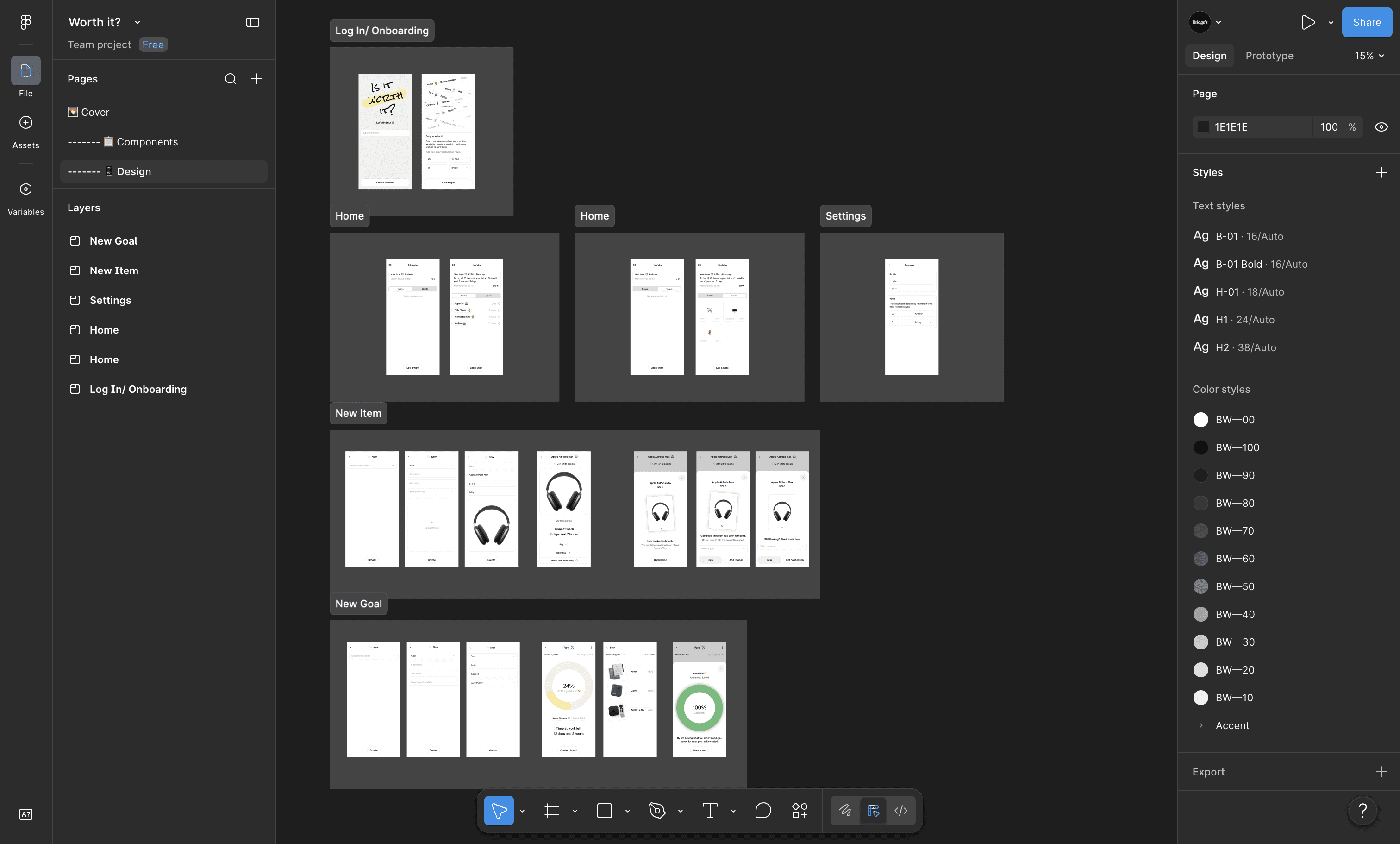
02 — Designing the product in figma
03 — AI Prototyping & Vibe Coding
04 — Iteration & Behavioral Refinement
Early Iterations
Initially, I experimented with Visual Studio Code and soft-coded prototypes to build the app experience. While this approach allowed for quick exploration, it quickly became difficult to maintain as a non-developer.
Small changes required too much technical overhead, which slowed down experimentation and made iteration frustrating instead of fluid.
After
Instead of organizing purchases by category, the app evolved into a system focused on: reflection, delayed gratification, and intentional progress.
Product Architecture
The final product architecture was designed around a continuous decision-making loop.
Not around transactions.
Core Loop:
Impulse → Pause → Reflection → Recovery
Set Your Rate
Users first establish a personal financial rhythm: income, saving pace, financial capacity, spending comfort
This creates contextual awareness for future decisions instead of treating all purchases equally.
Add Items
Whenever users feel tempted to buy something, they can add it into the system.
The act of logging the item already introduces friction into the purchase process.
Create Goals
Users create larger goals they care about. Goals transform avoided purchases into visible progress. Instead of: “I didn’t buy this.” The product reframes the experience as: “I moved closer to something more meaningful.”
Make Decisions (Buy, Pause, or Skip)
Over time, users revisit items and make a decision. The delay becomes part of the behavioural design. Many impulses naturally disappear with time.
The Challenges
Balancing friction
Too much friction makes the product exhausting.
Too little friction removes the behavioral value completely.
The experience needed to feel:
Emotional without becoming preachy
Reflective without becoming heavy
Useful without feeling like a productivity tool
Building the product while still defining the system.
Because the project evolved directly through prototyping, the architecture constantly changed:
Flows were restructured mid-build
Features evolved during testing
Interactions had to adapt continuously
UX consistency became difficult to maintain
Reflection
The most effective products don’t add control, they create awareness at the right moment.
The project taught me that some of the most interesting digital products are not the ones optimizing speed and efficiency, but the ones creating moments of awareness.
Overview
Designing a behavioural finance app that transforms impulse shopping into intentional decision-making.
Instead of focusing on budgeting after money is spent, the product focuses on the emotional and psychological moment before spending happens.
Users save products they want to buy, pause the decision, and over time decide whether to: buy the item, postpone it, abandon it or convert that money into progress toward personal goals
The product explores a simple idea: If people create distance between desire and action, they make better financial decisions.
Built using AI-assisted development tools, the project serves as both a functional prototype and an experiment in prompt-driven workflows, testing how structured inputs can shape product logic, user experience, and system behaviour.
Role
Founding Product Designer
Deliverables
0→1 MVP
Product Strategy
UX/UI Design
"Vide coding" 💅
Tools
Figma
Claude.ai
Replit
Timeline
01/02/2026 - 30/03/2026
THE-PROBLEM_01
Shopping has become frictionless. Everything in modern commerce is optimized for immediacy.
The result is that many purchases happen emotionally instead of intentionally. People often buy things because of boredom, stress, dopamine, insecurity, aspiration or trend influence.
But almost none address the actual decision-making process behind spending. I wasn’t interested in designing another finance dashboard.
Key-Decisions_02
Every part of the product is the result of a deliberate trade-off. Not what could be built, but what "should" exist to support better decisions.
Wants > budgets
Users don’t open the app to check budgets. They open it when they desire something.
→ The product starts from real behavior, not imposed structure.
Friction is a feature
Skipping an item is the action that creates value.
→ The system rewards restraint, not activity.
No dashboards
No categories, no analytics, no breakdowns.
→ The system rewards restraint, not activity.
Goals come later
Instead of forcing users to define a goal upfront:
→ Goals are built from accumulated skipped purchases.
Tests-and-validation_03
Assumptions were tested through simple, focused interactions. Each iteration explored how users behave at the moment of desire and what actually shifts that behavior.
The-Process_04
Worth It? was developed through a highly iterative workflow that combined traditional product design thinking with AI-assisted prototyping.
Rather than separating strategy, UX, UI, and implementation into isolated phases, the project evolved through continuous experimentation between:
ideation
interface design
behavioral systems thinking
prompt engineering
live prototyping
Steps:
01 — Sketching & Ideation
02 — Designing the product in figma
03 — AI Prototyping & Vibe Coding
04 — Iteration & Behavioral Refinement
Early-Iterations_05
Initially, I experimented with Visual Studio Code and soft-coded prototypes to build the app experience. While this approach allowed for quick exploration, it quickly became difficult to maintain as a non-developer.
Small changes required too much technical overhead, which slowed down experimentation and made iteration frustrating instead of fluid.
After
Instead of organizing purchases by category, the app evolved into a system focused on: reflection, delayed gratification, and intentional progress.
Product-Architecture_06
The final product architecture was designed around a continuous decision-making loop.
Not around transactions.
Core Loop:
Impulse → Pause → Reflection → Recovery
Set Your Rate
Users first establish a personal financial rhythm: income, saving pace, financial capacity, spending comfort
This creates contextual awareness for future decisions instead of treating all purchases equally.
Add Items
Whenever users feel tempted to buy something, they can add it into the system.
The act of logging the item already introduces friction into the purchase process.
Create Goals
Users create larger goals they care about. Goals transform avoided purchases into visible progress. Instead of: “I didn’t buy this.” The product reframes the experience as: “I moved closer to something more meaningful.”
Make Decisions (Buy, Pause, or Skip)
Over time, users revisit items and make a decision. The delay becomes part of the behavioural design. Many impulses naturally disappear with time.
The-Challenges_07
Balancing friction
Too much friction makes the product exhausting.
Too little friction removes the behavioral value completely.
The experience needed to feel:
Emotional without becoming preachy
Reflective without becoming heavy
Useful without feeling like a productivity tool
Building the product while still defining the system.
Because the project evolved directly through prototyping, the architecture constantly changed:
Flows were restructured mid-build
Features evolved during testing
Interactions had to adapt continuously
UX consistency became difficult to maintain
Reflection_08
The most effective products don’t add control, they create awareness at the right moment.
The project taught me that some of the most interesting digital products are not the ones optimizing speed and efficiency, but the ones creating moments of awareness.
Julia Martí / juliamarti.es
©
2019-2026
ლ(ಠ益ಠლ
Julia Martí / juliamarti.es
©
2019-2026
ლ(ಠ益ಠლ
Julia Martí / juliamarti.es
©
2019-2026
ლ(ಠ益ಠლ